An artistic-literary poster series on violent crimes against women.
The campaign #somethingiswrong reflects on the backdrop of violent crimes against women in society and highlights the issue of femicide from an artistic and activist perspective. #somethingiswrong uses and transforms the public space of cities and villages that surrounds us every day. It brings the structural dimension of gender-based violence into public discourse and stimulates debate. The posters are unsettling because, in contrast to advertising, they cannot be easily classified and yet convey a clear message: Sexism, multiple discrimination and violence against women concern us all.
The poster motifs of #somethingiswrong are always developed through dialogue. Artists exchange ideas with various experts as well as the curators, signifying that mutual learning is an essential part of the project.
The aim of the campaign is to continue to disseminate the posters and to find partners to reproduce them in other cities and regions of Europe. In this way, the collection of posters is constantly being expanded. All motifs can be downloaded from this website.
Edition 1
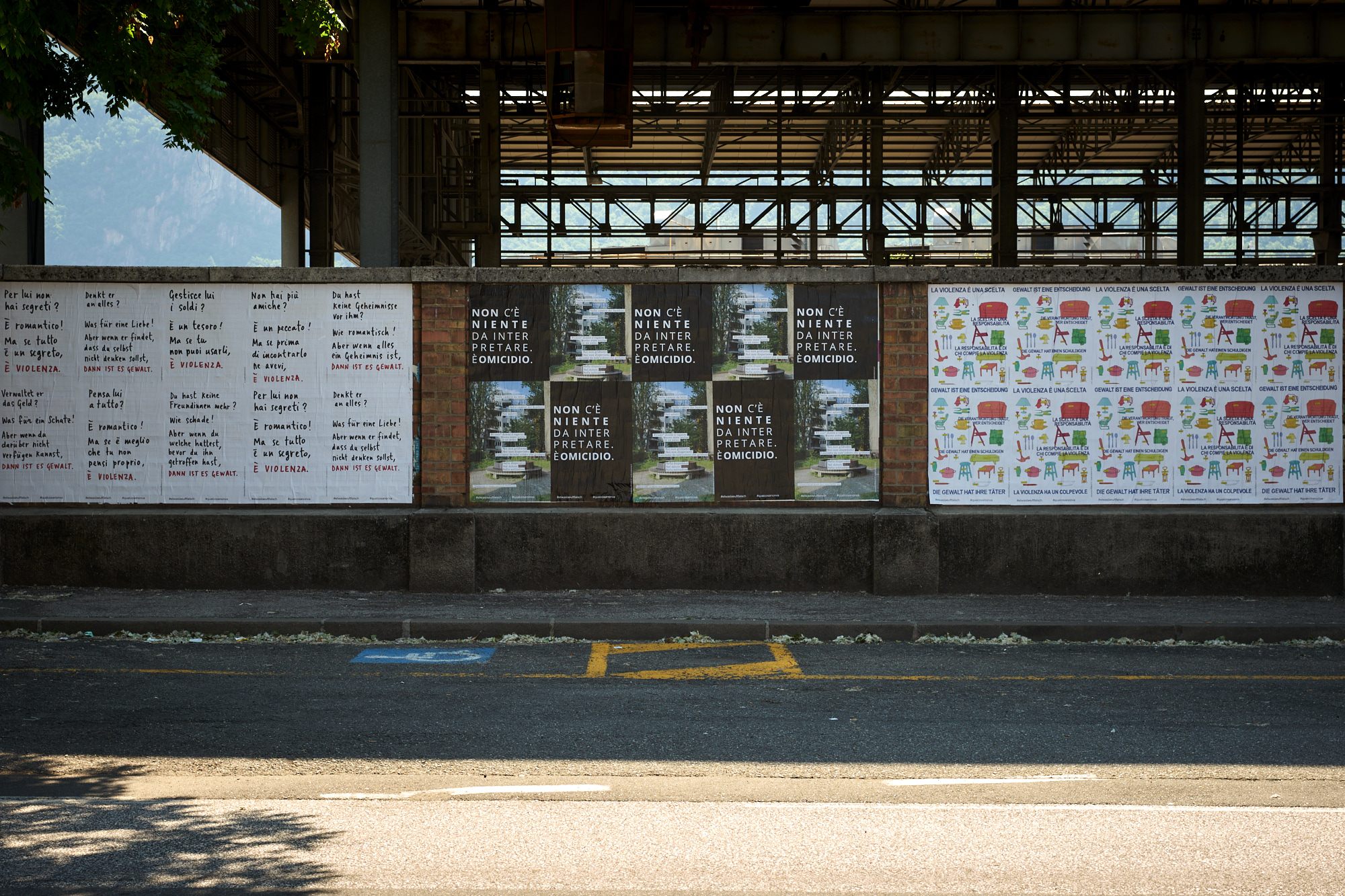
For the first edition of #somethingiswrong, five bilingual (German and Italian) poster campaigns opposing violence against women were created in South Tyrol in 2020-21. The motifs were designed by five pairs of artists and authors. The five poster campaigns used public and digital space to counteract the narratives of the normal, to contradict the silence and to stand on the side of those affected. The posters are the result of joint discussions between the artists and authors and the curators, local experts and activists.
Around 4000 posters were displayed on public billboards and advertising spaces in South Tyrol between June and September 2021. In addition, the posters of the first edition will be distributed nationally and internationally by individuals, associations, and public authorities.
The first edition of #somethingiswrong is a project by Lungomare in collaboration with Kunst Meran Merano Arte and Summer School Südtirol.
Artistic direction
Angelika Burtscher
Angelika Burtscher studied graphic and product design at the Faculty of Design and Arts at the Free University of Bolzano, and exhibition theory and practice at the University of Applied Arts Vienna. She has been working as a designer and curator since 2003. She is a partner in the design office Lupo Burtscher and founded the project and exhibition space Lungomare together with Daniele Lupo in 2003, where from the outset she has co-curated publications and artist-in-residency projects. In 2009 she completed a research year at the Jan Van Eyck Academie in Maastricht. Angelika Burtscher is the joint author of numerous books and magazines, including Martina Steckholzer, a Showcase (Publishing House for Modern Art Vienna, 2020), visible – where art leaves its own field and becomes visible as something else (Sternberg Press, 2010), and the magazine series Nord & – Süd – Life, Work, Economy in South Tyrol (2011 – 2015).
Daniele Lupo
Daniele Lupo is a designer and curator, and since 2003 the co-founder and co-curator of the project space Lungomare. Lungomare produces projects that explore and test possible relationships between design, architecture, urban planning, art, and theory. The projects interact with cultural and socio-political processes related to the region of South Tyrol. Since 2004 he has been a co-founder, member, and designer of the studio for design and visual communication, Lupo Burtscher. The studio primarily pursues a multidisciplinary design approach and is interested in the social and cultural impact of projects on public space. It develops projects in the fields of communication design, product and exhibition design, and curatorial work. Since 2019 he teaches as a project leader on the Master in Eco Social Design at the Free University of Bolzano.
Martina Oberprantacher
Martina Oberprantacher studied art history at the University of Innsbruck and at the Free University of Berlin. After several years of work experience in the field of art and cultural mediation, she studied Exhibiting & Mediating at Zurich University of the Arts, working in parallel as a research assistant at the Institute for Art Education at the ZHdK. From 2013, she was head of education and outreach at the Städtische Galerie am Lenbachhaus and Kunstbau München until she took over as director of Kunst Meran Merano Arte in June 2020.
Maxi Obexer
Maxi Obexer, playwright and author, lives in Berlin. She studied comparative literature, philosophy, and theatre studies in Berlin. She has received prizes and scholarships for her works, including from the Akademie Schloss Solitude and the Akademie der Künste, as well as the Eurodram Prize and the Robert Geisendörfer Prize for “Illegale Helfer”. She has held guest professorships at Dartmouth College, USA, at the Universität der Künste in Berlin, and at Georgetown University in Washington, DC. She teaches regularly at the German Literature Institute in Leipzig. She founded the New Institute for Dramatic Writing (NIDS), and the Summer School Südtirol.
Artists and authors
Edoardo Massa graduated in graphic design from ISIA in Urbino and is concerned with illustration, comics, and scribing. For the last six years he has worked as a writer with the Festival of Science in Genoa. He works in theatres as a graphic presenter, for example whilst touring with Michela Murgia. He also works as an illustrator for Iperborea’s The Passenger Magazine. Recently he has been living in Bologna.
Eleonore Khuen-Belasi Playwright
Eleonore Khuen-Belasi is a playwright, as well as a student of philosophy. She was nominated for the Hans Gratzer Scholarship at Schauspielhaus Wien in 2018. She was invited to the Author’s Theatre Days in 2019 at the Deutsches Theater Berlin with her first play “ruhig Blut”. The premiere took place at the Deutsches Theater with a production by Schauspielhaus Graz. The play was published in the theatrical anthology “Dramatische Rundschau 02” by S. Fischer Verlag. Her second play “Himmel und Hirn” was published in March 2021.
She has received various work and residency grants from the Federal Ministry of Art/Culture Austria, the German Literature Fund, the Province of South Tyrol, and the Literary Colloquium Berlin, among others. She is currently writing her third play and her master’s thesis. She lives and works in Vienna.
Gülbin Ünlü Artist
Gülbin Ünlü is an artist who works in Munich where she studied painting with Prof. Markus Oehlen at the Academy of Fine Arts Munich. On graduating in 2018 she was awarded the Erwin and Gisela von Steiner Foundation Prize. She is part of the artist collective T.A.G. and VKP and worked as a committee member of the art space Lorraine13 FLORIDA. Ünlü’s artistic practice celebrates the mash-up, which is not least evident in her interdisciplinary approach that includes artistic collaboration, photo and video work, installation, performance, music, and painting. Since 2016, Ünlü has published various artist books and music albums. Amongst others her work has been exhibited at the Pinakothek der Moderne in Munich in 2020.
Ingrid Hora Visual Artist
Ingrid Hora is a visual artist born in 1976 in Bolzano, Italy, who lives and works in Berlin. In her multidisciplinary artistic production – ranging from performative interventions, installation and drawing to video and photography – Hora stages experiments that question socio-political conditions, and challenge collectivity, as well as the modality in which democratic processes are established.
Often starting from very context-specific knowledge, locally rooted traditions or historical turning points, Ingrid Hora develops artistic interventions that establish new temporary networks by creating collective moments of interaction. Objects, drawings, or sculptural elements are the requisites for her collective performative interventions – often staged in public spaces – which the artist orchestrates through a series of basic instructions. The question of the human part of a collective and its eagerness to act outside its individual domain, as well as how a collective acts outside its common context when a set of norms breaks down, is at the heart of many of Ingrid Hora’s projects. The artistic process itself is often a collective act of creation in which the artist seeks dialogue with other disciplines such as dance, literature, or music.
Maxi ObexerWriter
Maxi Obexer, playwright and author, lives in Berlin. She studied comparative literature, philosophy, and theatre studies in Berlin. She has received prizes and scholarships for her works, including from the Akademie Schloss Solitude and the Akademie der Künste, as well as the Eurodram Prize and the Robert Geisendörfer Prize for “Illegale Helfer”. She has held guest professorships at Dartmouth College USA, the Universität der Künste in Berlin, and Georgetown University in Washington DC. She teaches regularly at the German Literature Institute in Leipzig. She founded the New Institute for Dramatic Writing (NIDS), and the Summer School Südtirol.
Rosalyn D’Mello Feminist Writer
Rosalyn D’Mello (she/her) is a feminist writer, art critic, columnist, essayist, editor, and researcher. She is the author of “A Handbook for My Lover” (HarperCollins India – 2018). She writes a weekly feminist column for Mid-Day, a fortnightly column on contemporary art for STIR, as well as contributing regularly to OPEN. She is an Ocean Fellowship Mentor for 2021 and is currently working on a book for Oxford University Press based on her visits to South Asian artists’ studios, thanks to a research grant from the India Foundation for the Arts. Her freelance writing has been published internationally and included in anthologies. She is represented by David Godwin Associates. Rosalyn grew up in Mumbai and lived in Delhi for almost a decade. She now lives in South Tyrol, where she braves the harsh alpine winters by drawing on her sensual memories of the goan sun.
Senthuran Varatharajah Writer
Senthuran Varatharajah,, born 1984 in Jaffna, Sri Lanka. Studied philosophy and protestant theology in Marburg, Berlin and London. In 2016 came the publication of her multiple award-winning debut novel. “Before the Signs Increase” published by S. Fischer. Varatharajah’s second novel “Rot” (Hunger) will be published in spring 2022, also by S. Fischer.
Sophie Utikal Textile Artist
Sophie Utikal (1987, USA) was born in the same year that Gloria E. Anzaldúa published “Borderlands”. Since then she has lived in many places and graduated from the Academy of Fine Arts in Vienna in 2019. Today she lives and works in Berlin, Neukölln.
In her work, Utikal combines textile fragments to create self-portraits in large-scale fabric paintings where the black thread remains visible – a sewing technique used across generations by the women in her family in Colombia. Her use of textiles to represent the negative form of her body combines with Anzaldúa’s method of auto-historia. Tears, waterfalls, rivers, and oceans permeate her bodies in order to tell stories based on traumatic but also pleasant experiences of migration and self-empowerment as a woman of colour in Germany. Starting from a decolonial perspective, her textile works are dedicated to forms of unfolding bodily knowledge such as feeling, perceiving and being, that go beyond rationality. She is constantly searching for a new consciousness that incorporates the body as an actor in a possible healing process.
Teresa SdralevichGraphic Designer and Illustrator
Teresa Sdralevich, graphic designer, freelance illustrator and author, lives and works in Belgium. Born in Milan in 1969, she moved to Brussels in 1994 after graduating in political science from the University of Bologna, where she briefly attended courses in graphic design and illustration. In 2005, she set up a screen-printing workshop in the Belgian capital, which was also open to other artists. Her preferred themes are of a social, political, and cultural nature, which she addresses through the design of posters for which she conceptualizes texts and images.
In addition to collaborating with associations and public institutions, she also works with publishers and journals. She conducts workshops regularly in museums, academies and at festivals throughout Europe and beyond. Her latest book, “Poster Power! Great Posters and How to Make Them” (Cicada, 2017) is published in Italy by Corraini.
Wissal Houbabi Activist, Artist
Wissal Houbabi. Activist, artist, and writer. Associate expert of “Razzismo Brutta Storia”. Co-founder of the art collective ZufZone from Trieste. She published “Manifesto per l’antisessismo del rap italiano” for EUT and an investigation on hip-hop “pimpology” for PalGrave MacMillan. She has written for VICE-Noisey, Jacobin and Agenzia X and is one of the authors of Future (effequ). She writes about anti-racism, feminism, hip-hop and identity.
She won second prize in the 2019 Alberto Dubito National Prize for Poetry with Music. Wissal has participated with her poetry in national events and festivals, projects with IUAV, Cantieri Meticci and others. She has shown her drawings and works in solo and group exhibitions, including at the Turin Book Fair in 2017.

Edition 2
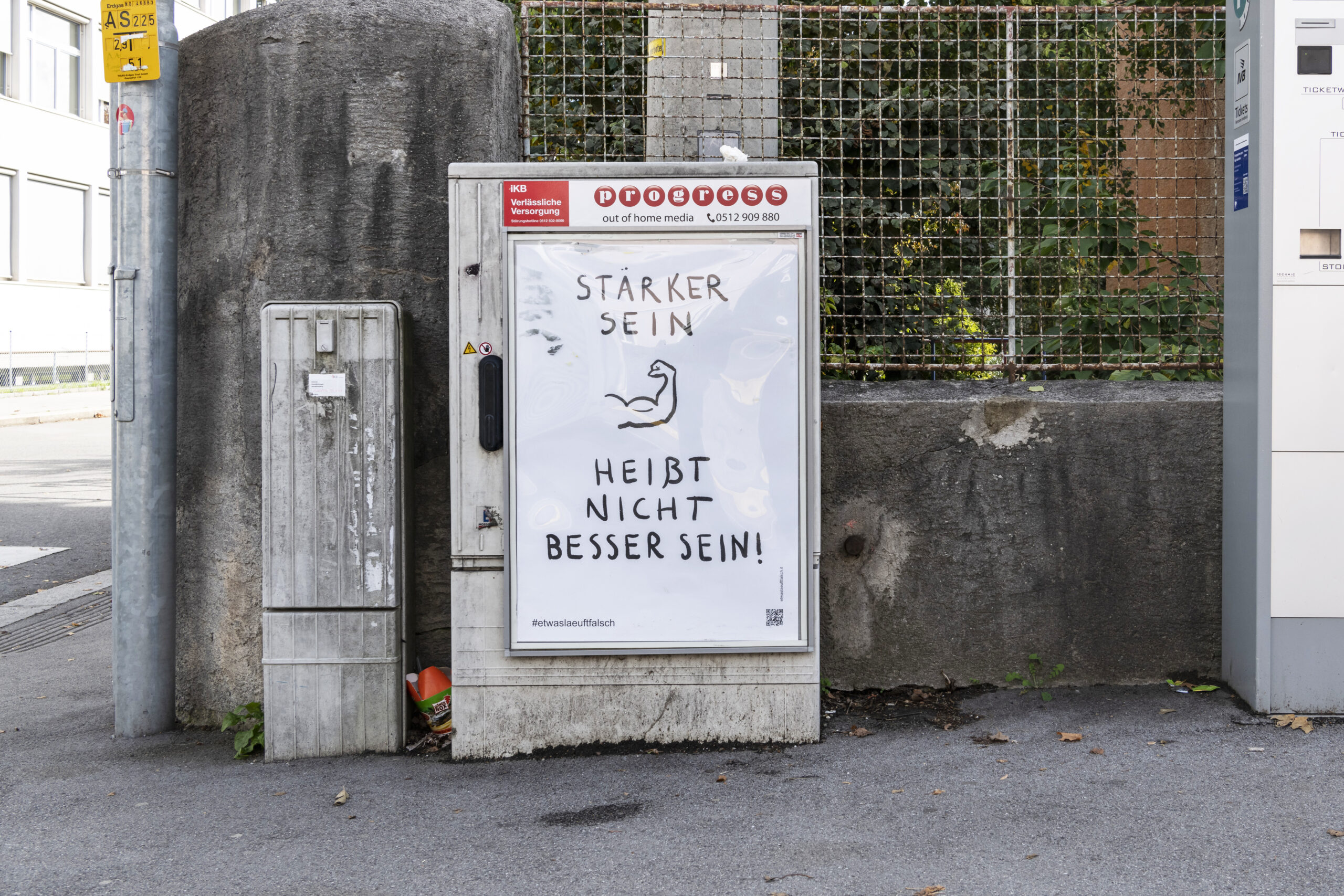
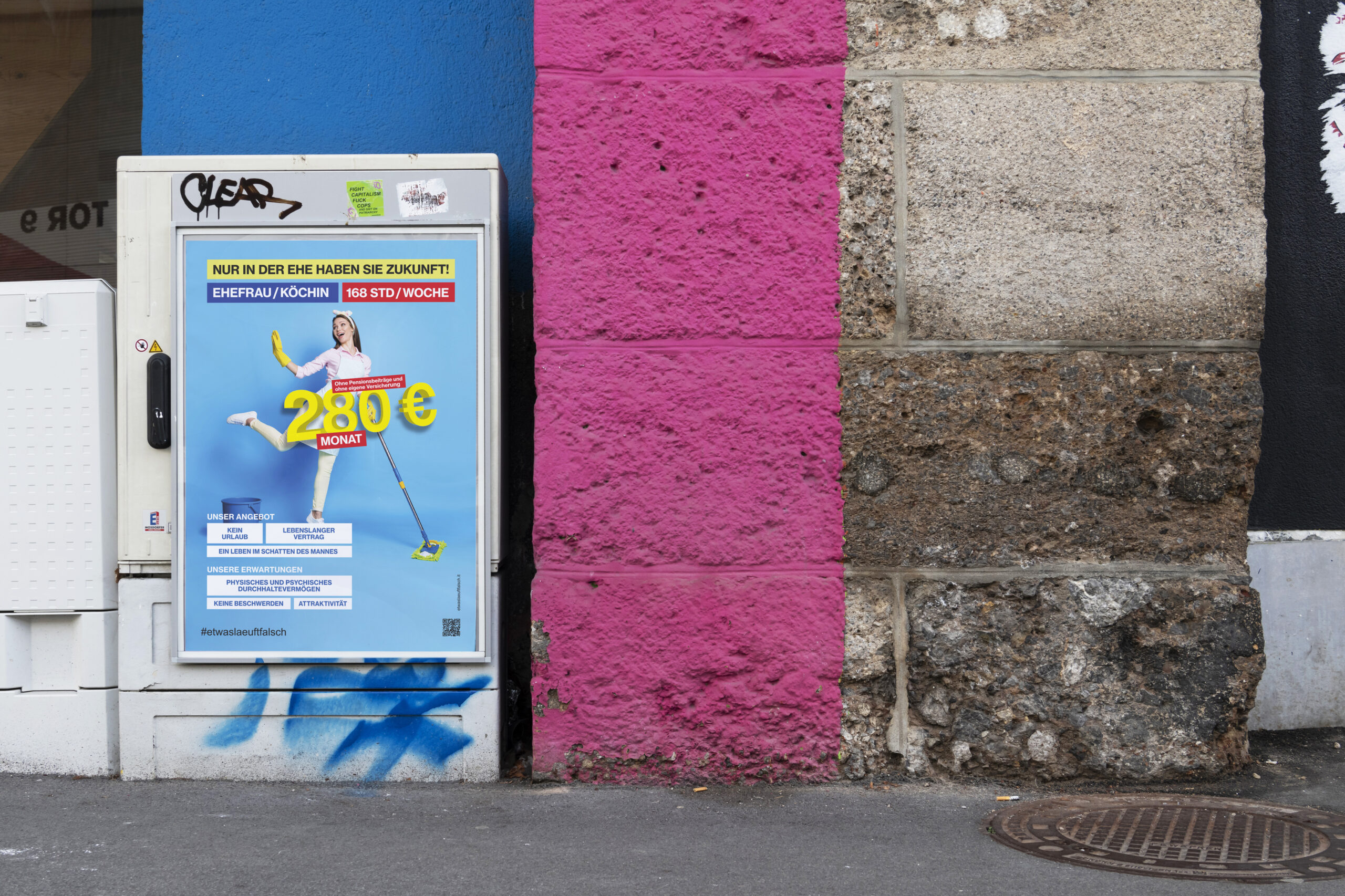
Building on the first edition (South Tyrol, 2021), three campaigns opposing violence against women were created in 2022, illuminating the topic from an artistic and activist perspective specifically for the Tyrol region. Many people are not aware of the figures and do not know that on average a woman is killed every 5th day in Austria. However, femicides are only the tip of the iceberg, because the forms of violence against women are countless, ranging from physical, psychological, sexualised and economic to structural violence.
The posters by the three artists Aldo Giannotti, Stefanie Sargnagel and Kateřina Šedá focus on violent crimes against women and address different aspects of violence against women. They are direct and confront people in public space in an immediate way. With irony and sarcasm, they find a language for something that is not readily spoken about. Each of the three campaigns with a total of five motifs is based on a collaborative process between artists, curators and representatives of violence protection organisations. In order to deepen the examination of the topic and to enable a more intensive engagement, a mediation programme will take place in Tyrol in the form of bus-stop talks. More on the exact dates in October and November 2022 you find on: www.lungomare.org
The second edition of the project is developed within the framework of Art in Public Space Tyrol (KöR) 2022.
Artistic direction
Angelika Burtscher
Angelika Burtscher studied graphic and product design at the Faculty of Design and Arts at the Free University of Bolzano, and exhibition theory and practice at the University of Applied Arts Vienna. She has been working as a designer and curator since 2003. She is a partner in the design office Lupo Burtscher and founded the project and exhibition space Lungomare together with Daniele Lupo in 2003, where from the outset she has co-curated publications and artist-in-residency projects. In 2009 she completed a research year at the Jan Van Eyck Academie in Maastricht. Angelika Burtscher is the joint author of numerous books and magazines, including Martina Steckholzer, a Showcase (Publishing House for Modern Art Vienna, 2020), visible – where art leaves its own field and becomes visible as something else (Sternberg Press, 2010), and the magazine series Nord & – Süd – Life, Work, Economy in South Tyrol (2011 – 2015).
Veronika Hackl
Veronika Hackl is a social scientist and cultural worker. Her work constantly moves within the field of between curation, mediation, production and research. She is engaged with community art, participatory video, anti-discriminatory art practice and collaborative processes, at both a theoretical and practical level. She engages with urban and social issues artistically in several collectives, including Admirabel – Was kostet? (2016-17), Mein letztes Auto (2019-20) and Stadt//schichten (2021-22). Between 2013 and 2020 she curated and created neighbourhood art projects for The Stand 129 at Viktor Adler Markt and the Kulturhaus Brotfabrik in the Favoriten quarter of Vienna. From 2020 to 2021 she worked for the Social Design Studio at the University of Applied Arts Vienna, with a focus on Floridsdorf. Her collaboration with Lungomare began during a work residency of several months in Bolzano in autumn 2021.
Daniele Lupo
Daniele Lupo is a designer and curator, and since 2003 the co-founder and co-curator of the project space Lungomare. Lungomare produces projects that explore and test possible relationships between design, architecture, urban planning, art, and theory. The projects interact with cultural and socio-political processes related to the region of South Tyrol. Since 2004 he has been a co-founder, member, and designer of the studio for design and visual communication, Lupo Burtscher. The studio primarily pursues a multidisciplinary design approach and is interested in the social and cultural impact of projects on public space. It develops projects in the fields of communication design, product and exhibition design, and curatorial work. Since 2019 he teaches as a project leader on the Master in Eco Social Design at the Free University of Bolzano.
Artists
Aldo GiannottiArtist
Aldo Giannotti (born in Genoa in 1977) is an artist who has lived and worked in Vienna since 2000. He studied at the Accademia di Belle Arti di Carrara (Italy), the Academy of Fine Arts Wimbledon (England), and the Academy of Fine Arts in Munich (Germany). Drawing occupies a central role in Aldo Giannotti’s artistic practice for communicating socio-political concepts. The artist is an astute and critical observer, and for his mostly site-specific works he uses a variety of forms of expression such as drawing, photography, video, installation, and performance.
His work has been shown in solo and group exhibitions, most recently at MAMbo – Museo d’Arte Moderna in Bologna, Projektraum Viktor Bucher Vienna, Kunstpavillon Munich, Mumok in Vienna, Radvila Palace Museum of Art in Vilnius, Kunsthaus Graz, Albertina Vienna, Škuc Gallery in Ljubljana, Taxis Palais Kunsthalle Tirol.
Kateřina ŠedáWriter, cartoonist
Kateřina Šedá (born in 1977 in Brno, czech republic) is an artist who lives and works in Brno. She studied at the Academy of Fine Arts in Prague. Kateřina Šedá’s work is close to social architecture and her interest is in communities and socially conceived events, often involving dozens or hundreds of people, who have nothing to do with art. The events usually take place directly in villages or on the streets of cities. The experimentation with interpersonal relations aims to free the participants from stereotypes or social isolation. The artist’s works speak of a sense of belonging and of a responsibility towards the community, critically questioning the concept of “home”.
She is currently developing her projects at the Artpark Buffalo Niagara in the USA, the Milton Keynes Art Centre in England and for Kunst und BAU (Art and Construction) in Zurich. The artist has also presented projects at LIAF in Norway, IHME in Helsinki, the Architecture Biennale in Venice and MMOMA in Moscow.
Stefanie SargnagelArtist
Stefanie Sargnagel (born in 1986 in Vienna, Austria) is a freelance author and cartoonist. She studied at the Academy of Fine Arts in Vienna. From 2009 to 2012 she published the fanzine “Extrem deprimierende Zines” (extremely depressing mags) From 2013 her books were published: “Binge Living” (2013), “Fitness” (2015), “In the Future We Are All Dead” (2016), “Status Messages” (2017) and “Dense” (2020). She regularly draws cartoons for Falter, Frankfurter Allgemeine Quarterly, Augustin and WIENERIN. Her reporting appears on Bayerischen Rundfunk (Bavarian Broadcasting), and in the ZEIT, VICE and Süddeutsche Zeitung (newspapers/magazines). In 2016 she won the Audience Award at the Ingeborg Bachmann Prize, the Special Prize of the Austrian Cabaret Prize in 2017 and the Promotional Prize of the Sondermann Prize for Comic Art in 2019. She is a member of the authors group Wiener Grippe and the Hysteria fraternity.
Participating institutions
East Tyrol Women's Centre
Counselling for girls and women
The Frauenzentrum Osttirol (East Tyrol Women’s Centre) advises and assists girls and women in difficult circumstances and supports them in developing their decision-making skills and asserting their needs. One of the main concerns is to make the social discrimination of women visible and to support and strengthen them in their self-determination and personal responsibility. The counsellors are on the side of the client, the counselling setting is based on anonymity, confidentiality, and voluntariness. The “Frauenzentrum Osttirol” is a victim protection institution of the Tyrol province and a women’s service centre of the federal government.
As an interdisciplinary team, it offers guidance and counselling at a legal level, provides workshops and counselling for girls, and engages in work on prevention.
Mannsbilder (menfolk) Tyrol
Counselling for men and boys
The independent association Mannsbilder (Menfolk Tyrol) offers free and confidential counselling for men and boys in five districts of Tyrol. Both the association and the counselling centres are not bound to any political party, political ideology, or religion. The focus of their work is solely on the specific individual that is, the man or the male youth looking for contact and help. The association is also an educational centre and meeting centre, with training opportunities and discussion groups exclusively for men.
Women against VIOLENCE
Counselling and awareness-raising on sexualised violence
The counselling centre Frauen gegen VerGEWALTigung (Women against VIOLENCE) has been in existence since 1982. It is a specialised centre on the topic of sexualised violence against women and girls from the age of 16, and a state-recognised victim protection institution. Founded as a 24-hour emergency hotline, it has developed over the years into a counselling centre that also focuses on prevention and public relations work. The association Women against VIOLENCE is staffed exclusively by women professionals. The work is founded on a feminist and socio-politically active stance. The organisation is an independent, non-partisan and non-denominational association and is financed by public funds.